
On July 23, 2013 a well operated by Walter Oil and Gas in the Gulf of Mexico (GOM), ST Block 220, had a Loss of Well Control (LOWC) during well completion operations which escalated to an explosion and fire causing damages of $10 million. The BSEE panel investigation concluded that the main cause of this accident was the failure of the crew to detect a kick triggered by an unbalanced bottom-hole pressure while tripping the drill string from the hole. While the signs of the kick were manifested by the rapid return flow of the drilling mud to the surface, the kick was not acted upon until the well began to flow from the top of the drill pipe.
In addition to the Walter Well event, findings and conclusions derived from numerous BSEE accident investigation reports showed failures to detect kicks in their early stages persist in the post-Macondo era due in part to the lack of effective detection instrumentation.
In response to the Walter Well LOWC and findings from numerous BSEE TAP studies, an assessment under the BSEE BAST Determination Process was initiated to identify and evaluate EKD technologies that may mitigate the influx or loss of wellbore fluid during drilling, completions and workover operations and therefore increase safety on the OCS. As illustrated by the following Timeline, the EKD Assessment was initiated in 2016.
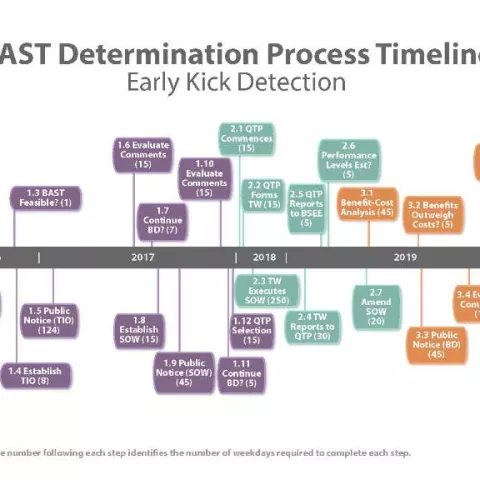
To date, the first five steps of the BAST DP have been completed or are in process, as follows:
STEP 1.1: Safety Issue
BSEE’s review of related OCS incidents to determine whether sufficient evidence supports earlier BSEE findings that a potential safety issue exists on the OCS. BSEE concluded that such a safety issue exists.
STEP 1.2: Assessment and Findings
BSEE’s Assessment of the safety issue and whether commercially available technology solutions exist that could mitigate the issue analyzed in Step 1.1 above. BSEE met with OCS stakeholders, including drillers, operators, and Original Equipment Manufacturers (OEMs) of kick detection equipment to evaluate systems available on the open market with applicability to OCS operations and capable of providing early warning of downhole kicks. BSEE concluded that various EKD systems are commercially available that could potentially be used to provide improved EKD and reduction or prevention of LOWC events.
STEP 1.3: BAST Feasibility Analysis
BSEE Directors’s finding from the BAST Assessment conducted in Step 1.2. Director concluded that it is likely that there are cost-effective technologies that will mitigate the potential safety issue and to proceed with the BAST Determination.
STEP 1.4: Technology Improvement Objective
BSEE developed the following Technology Improvement Objective (TIO) which has the potential to improve safety, health or environmental protection associated with LOWC during well operations (drilling, tripping, completion, workover, suspension, etc.).
Based on an evaluation of commercially available technology, what is the lowest volume of formation fluid influx (in bbls) that can be detected and the earliest detection (in seconds) of the influx measurable in a cost effective and feasible manner?
This TIO performance level could be used to define an acceptable response time for detection of kicks of a specific size.
STEP 1.5: Public Notice Document
BSEE’s Public Announcement of intent to evaluate EKD under the BAST Determination Process. BSEE presented their work to date and the EKD TIO at the April 17th BAST Technology Solutions Forum in Houston to allow for open dialogue and stakeholder feedback. The Forum generated a series of questions which BSEE provided answers to during the forum.
STEP 1.6. Evaluate Comments
Upon the receipt of public comments under Step 1.5 above, BSEE evaluated all comments and incorporated many in order to improve the quality and direction of the BAST Determination Process.
STEP 1.7. Continue BAST Determination
Based on BSEE’s review of the TIO comments and on comments received during and after the April 17th BAST Technology Solutions Forum, the Director will decide whether to continue the BAST Determination Process.
Comments on the BAST Program and/or on the EKD BAST Determination can be provided via BSEE’s BAST webmail address (bastweb@bsee.gov).