
Dielectric fluids are electrically non-conductive liquids often found in underwater electrical cables and power generation equipment, such as associated with offshore wind turbines. To accurately model spills in oil spill trajectory models, such as WebGNOME, the material properties of available dielectric fluids are needed. Through a contract with the US Coast Guard Academy, Coast Guard Academy cadets characterized the physical and chemical properties of fresh and weathered mineral based, synthetic, and ester-based dielectric fluids. This contract was for a 17-month research effort, valued at $42,477.16.
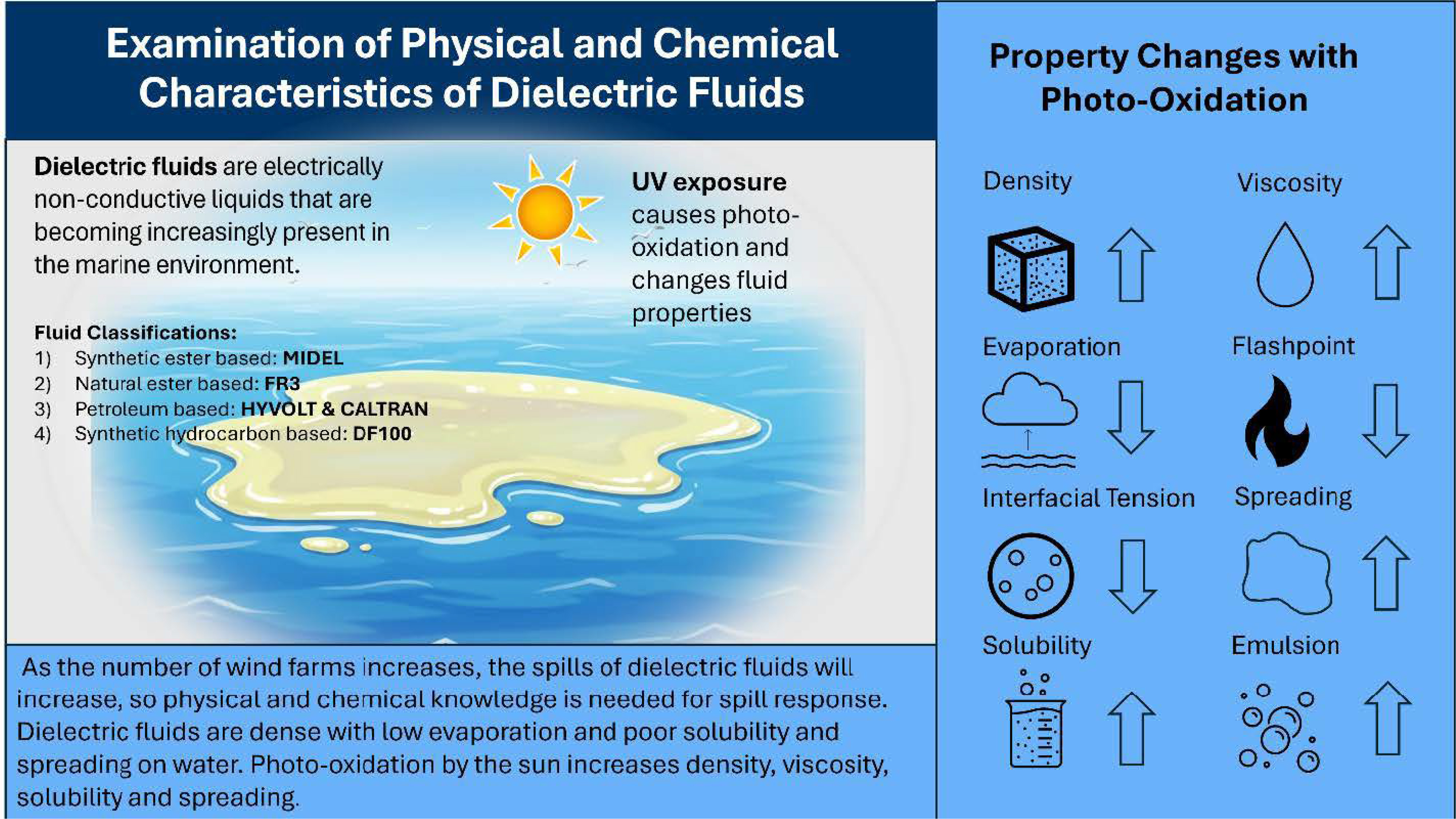
Five dielectric fluids were selected for characterization: mineral oil-based HYVOLT II NG and CALTRAN 60-30, synthetic oil DF 100, and ester-based ENVIROTEMP FR3 and MIDEL 7131. The dielectric fluids were tested before and after photooxidation, performed using a Q-Lab Inc. LX-5090B-TM Q-SUN Xe-1-B Xenon test chamber. The samples were exposed to an equivalent of three summer days of photooxidation expected in northern US latitudes. During the photooxidation experiments, it was determined that the fluids absorb light wavelengths between 300 nm and 400 nm. The goal of this project was to characterize the dielectric fluid density, viscosity, evaporation, flashpoint, interfacial tension, spreading, solubility, and ability to form emulsions. Density and viscosity of all fluids increased because of photooxidation, and all fluid densities increased at lower temperatures. Most dielectric fluids had no appreciable evaporation during photooxidation, with the highest amount of evaporative loss reaching 5% for one sample. The limited vaporization resulted in the flashpoint of the samples ranging from 128 °C to 221 °C. Interfacial tension was observed to increase at higher temperature, but without statistical significance. Spreading and solubility were all negligible before photooxidation but increased significantly after exposure to sunlight. Finally, no emulsions were observed during the experiment.
The changes induced by photooxidation indicate that dielectric fluids will respond differently compared to previously studied crude oils or petroleum products. These results demonstrate that dielectric fluids must be modelled with relevant response technologies to gain proper insight into their effectiveness. Further research will provide responders with more accurate decision-making tools to aid in responding to an on-water dielectric fluid spill.
The project is now complete.