
State-of-the-Art Modeling Interactions Between Spilled Oil and Shoreline Oil Holding Capacity
Abstract: Advancing Understanding of Oil-Sediment Interactions for Enhanced Oil Spill Response Modeling: A Continuation Study
This multiphase project will improve the understanding of shoreline oil holding capacity and the modeling capabilites of shoreline oil holding capacity. A comprehensive update has not been conducted since the completion of the previous Marine Minerals Service (MMS, BSEE precursor) project in 2007 that reviewed the transformations oil undergoes upon stranding and the multitude of factors influencing its behavior, including physical and chemical properties, weathering processes, and shoreline characteristics. Building upon the prior research effort, the project will inform oil spill modelers and responsers by providing insights into the hydrodynamics and fate of oil in nearshore areas. This will be accomplished by identifying advances in the understanding of oil spill interactions with various shoreline types and oil retention, fate, and holding capacity on sediment beaches by synthesizing data from various sources and updating holding capacity algorithms. Then, an analysis of Shoreline Cleanup and Assessment Technique (SCAT) data and existing shoreline oiling models will be conducted to quantify penetration of oil into sediments and determine if any additional factors should be included in new shoreline holding capacity models. Finally, models will be updated and the information gathered through the project will be synthesized in a final report. The results will assist in accurately estimating the rates of spilled oil entrained on the shorelines, especially on sediment beaches, as well as oil fate, retention and holding capacity.
The 14-month project, with a budget of $121,774.20, will deliver a comprehensive report reflecting the current state of science and informing future research and response strategies. By synthesizing data on oil detection, fate and transport, sequestration, and weathering, the project aims to inform oil spill trajectory and risk modeling, enhancing decision-making processes for responders and policymakers. Additionally, the results from this study provide will insights into the degrees of penetration into substrates that can be used by oil spill response personnel. This will aid BSEE and BOEM in regulatory and response capabilities such as spill modeling and planning and the evaluatoin and exploration and development plans and in the preparation of NEPA documents.
Estimated completion date: 6/30/2025
Date of Summary 07/23/2025
Short title: Shoreline Holding Capacity Modeling Study
This project aimed to enhance the regulatory and response capabilities of the Bureau of Safety and Environmental Enforcement (BSEE) and the Bureau of Ocean Energy Management (BOEM). This study collected and evaluated updated information on shoreline holding capacities and relevant models through a comprehensive literature review focused on oiled shoreline retention. The project provided BSEE with a review of the state-of-science and an updated modeling approach pertaining to shoreline holding capacities in the event of an oil spill. The study built off a project funded by the US. Department of the Interior Minerals Management Service (MMS) in 2007 to evaluate the state-of-science as it related to oil interactions with sediments on beaches (Etkin et al. 2007) Since the 2007 report was completed, there has been significant effort throughout the oil spill science and response community to better understand the interactions between oil and the nearshore environment.
The objectives of this project included performing a literature review, evaluating current modeling practices, and developing an updated approach for modeling shoreline oil interactions. A multiphase approach was completed to address the objectives outlined above. The first phase included a comprehensive review of findings and research gaps outlined in Etkin et al. (2007-2008) as they are still exceptionally relevant today. The second phase required an updated literature review leveraged conference proceedings, peer-reviewed journal publications, guidance documents, technical reports, and oil spill related books. Given the focus on the response timeframe (~1-month) and application of findings to operational oil spill models, approximately 60 relevant documents, papers, and reports were reviewed and summarized. Although research to date provides qualitative information regarding the processes controlling shoreline oil retention, field and laboratory experiments have generally been designed to capture a limited number of mechanistic processes, such that the information cannot be used to inform algorithm development for application to operation oil spill models.
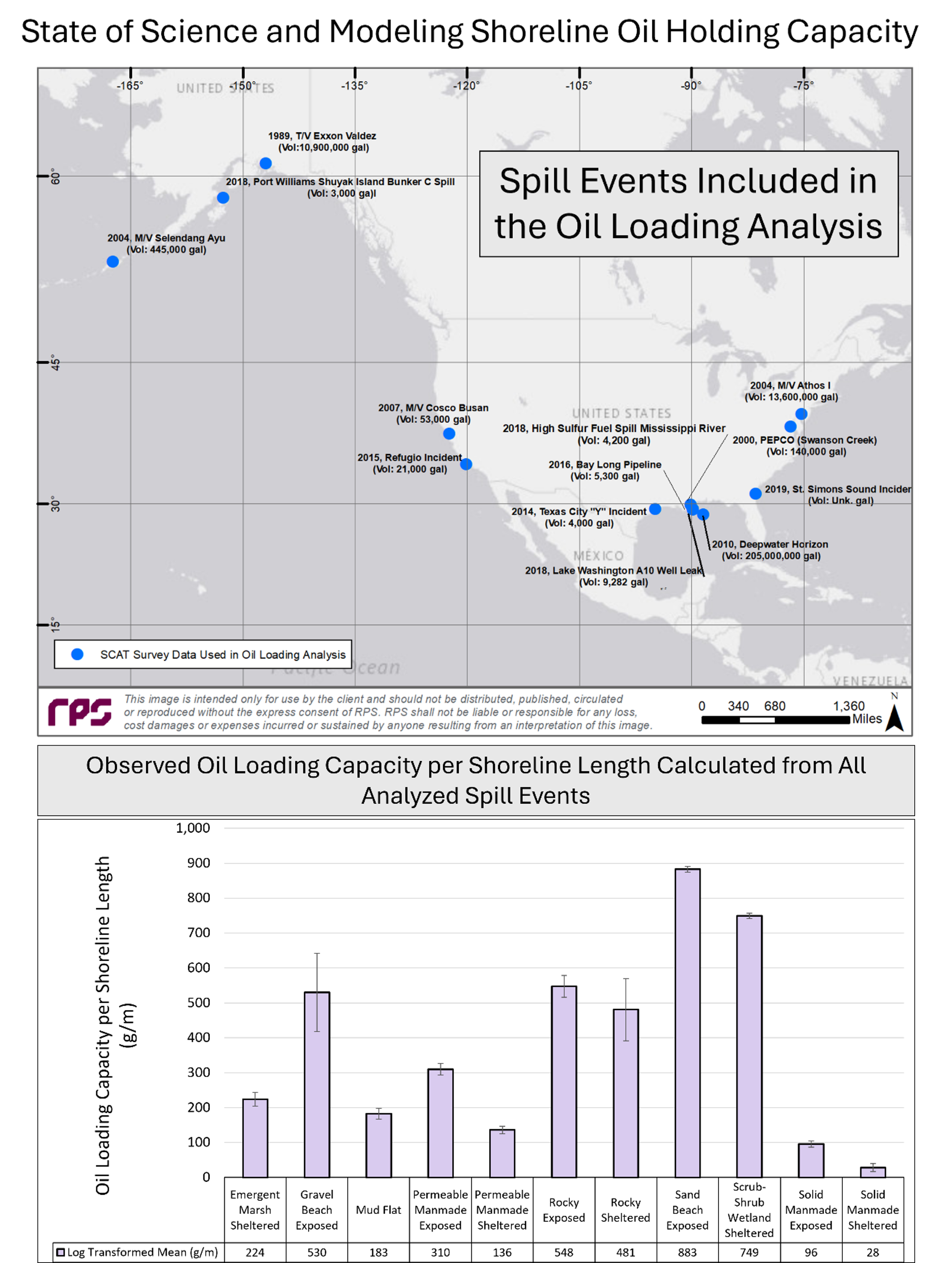
This assessment analyzed data from 13 different historic spill events covering a range of shoreline types and spill conditions. Using field data to develop shoreline oil holding capacities inherently captures the complexities of oil retention on specific shoreline types (e.g., sediment composition) and environmental conditions (e.g., tidal fluctuations, wave energy). The oils included in this analysis were crude oils, emulsified oils, and intermediate-heavy fuel oils. Therefore, the results from this study can be applied to spills with those oil types as well as light crudes that have weathered or emulsified prior to reaching the shoreline (e.g., Deepwater Horizon). This study provides modelers with an updated oil loading capacity data set that can be applied in operation oil spill models depending on the spill-specific conditions and shoreline types.